Bal’s remembrances of the Residencia de Estudiantes sound like Proust’s world of sensations: Moreno Villa painting, or talking about art; sitting in the garden with Ortega or Juan Ramón Jiménez; the smell of dampness and soap in the rooms, the murmur of the poplars, the sense of well-being. Bal was a model resident, able to play the piano, to welcome a distinguished guest, and to organize concerts; and he did all that with that sense of confidence that only shy people know how to do. The Residencia made him a gregarious, mature, cultured man, and allowed him to meet and befriend people such as the musicologists and paleographers Curt Sachs and Higinio Anglés, the philologist and director of the Center for Historical Studies, Ramón Menéndez Pidal, and the Residencia’s director, Don Alberto Jiménez Fraud, who treated him as a son and ended up making him his alter ego.
In those days, to be a member of the Residencia was a guarantee of obtaining a versatile and comprehensive education. Bal admired and absorbed the Residencia’s teaching methods and eventually became the chronicler and a compelling disseminator of the excellence of the institution.
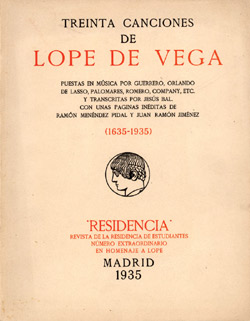
He met there the British hispanista J. B. Trend, who would open the doors of Cambridge University for him, by inviting him years later as lector of Spanish. He also met his future wife, Rosita, at the Residencia, probably after a concert by Ravel or Poulenc; and the Residencia published his Treinta canciones de Lope de Vega, his best business card, edited by Juan Ramón Jiménez, with a foreword by Ramón Menéndez Pidal.
|