





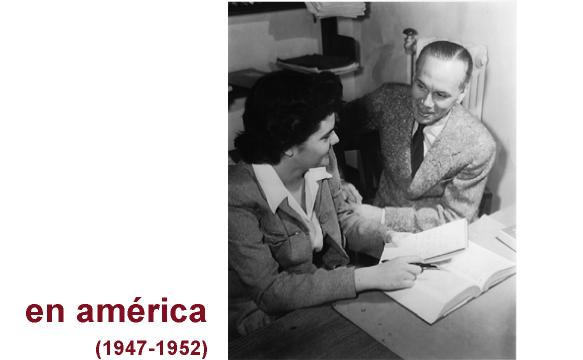
Luis Cernuda with student Berenice Matlowsky, at Mount Holyoke College, November 1947. Mount Holyoke College archives, Massachusetts
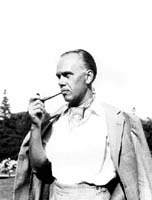
Luis Cernuda at Middlebury College, summer 1948
Cernuda arrived in Mount Holyoke, Massachusetts, in September 1947. He had left behind the misery of Europe devastated by war, and for the first time he had a well-paying job. He also had the pleasure of seeing his good friend, Concha Albornoz, along with the splendor of the American countryside in autumn.
However, the joy of his arrival soon dissolved. Cernuda came to hate the permanent winter snow. Moreover, despite Concha’s proximity, he felt intellectually isolated after a few months. He traveled only occasionally to visit other universities. In the fall of 1947, he went to Harvard, in Boston, to give a lecture on “Cervantes, el poeta,” as part of a series commemorating the 400th aniversary of Cervantes’s birth.
The following year he traveled throughout New England and New York, rediscovering the joy of his first arrival when he reunited with people he once loved, such as Pedro Salinas and Jorge Guillén. But the old sensitivities surfaced again and not even the summer term of 1948 in Middlelbury College, where he taught along with other Spanish intellectuals in exile, dissuaded him from his idea of leaving the United States as soon as he could. The publication of the second edition of La realidad y el deseo in Mexico, 1940, aroused his interest to visit that country, where he traveled for the first time in the summer of 1949.
Cernuda could not feel happier in Mexico: he had not only escaped from the mist and cold of the north, but after 11 years spent in English-speaking countries he could hear people around him speaking Spanish. He was welcomed by old friends, such as Manuel Altolaguirre, Concha Méndez, Emilio Prados, Ramón Gaya, and José Moreno Villa.
He also made new Mexican friends, such as the painter Manuel Rodríguez Lozano, the poet Enrique Asúnsulo, and the musicians Salvador Moreno and Ignacio Guerrero. He went to Acapulco with those musicians for the first time, a town he would later visit many times.
During the 1949-1950 academic year, Cernuda finished his third poetry book written in exile, Vivir sin estar viviendo, and began two new works: Con las horas contadas and a collection of prose poems, Variaciones sobre tema mexicano. In the latter work, the poet tried to capture and celebrate the character and spirit of the Mexican people, and also evoke the air, light, vegetation and the beaches of Mexico, a country which in many respects resembled the Andalusia he had known in his childhood and youth.
In June 1951, Cernuda, who sought a way to return to Mexico, took an eight month leave of absence from Mount Holyoke. Once in Mexico, he fell in love with a young man named Salvador Alighieri, an intense experience that inspired the series Poemas para un cuerpo. When his Mexican visa expired, Cernuda visited Havana between November 1951 and February 1952 after he was invited by José Rodríguez Feo. He lectured about Spanish poetry and met with the group of poets in the Orígenes periodical, especially the Cuban writer José Lezama Lima, and María Zambrano, who was was living in Havana at that time.
By then, thanks to the friendship of a young Spanish poet and critic, José Luis Cano, Cernuda began to reestablish literary contacts with Spain, where Ocnos’ second revised (and censored) edition was published. Cano also invited him to write for the Ínsula periodical. However, the country that interested the poet at the time was Mexico. In November 1952, he returned to Mount Holyoke, resigned and, with some savings but no job, he moved to Mexico City.

