





after gallo
Although a third issue of gallo was never published and the adventure seems to stop with the second issue, the journal continued on its way for some time.
First, it remained as a possibility that floated in the minds of its creators. The letters exchanged between Federico García Lorca and other editors and contributors after the appearance of the second issue in April, clearly revealed preparations for the third issue. They already had works by Salvador Dalí, Sebastiá Gasch, Lluís Montanyà, José María de Cossío, Enrique Gómez Arboleya, Gerardo Diego, and Ernesto Giménez Caballero ready to be published in the journal.
Gallo also remained as a symbol of a particular vision of Granada, and served as an important platform for innovative ideas about art, literature, architecture, and so on. Gallo continued to exist until the possibility of publishing a third issue died altogether.
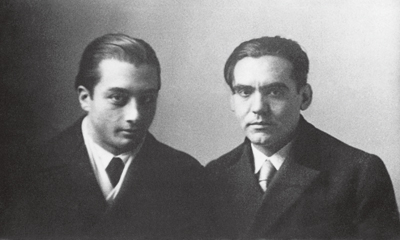
The purpose of "Noche de gallo," a meeting that took place in the Ateneo of Granada on October 27, was to discuss the state of the artistic and scientific disciplines, following the formula of exchanging knowledge that Lorca had known and enjoyed in the Residencia de Estudiantes in Madrid. The "Night of the gallo" was also an opportunity to discuss in public the journal’s fundamental proposals, such as the brainstorming of ideas, its poetry, and its experimental aspects. Among the participants there were Fernando de los Ríos, Joaquín Amigo, Manuel López Banús, Carlos Fernández Casado, Enrique Gómez Arboleya, Francisco Menoyo, and Federico García Lorca, who read his "Sketch of the new painting," accompanied by a slide show.
The last letters of Joaquín Amigo and López Banús to García Lorca were in reality a desperate effort to keep the journal alive. Amigo wrote: "You are a dog; we never hear from you. But we are so permeated with your dynamism that your silence cannot discourage us.” Manuel López Banús wrote: "We are desperate. We cannot do anything without you. And although we know you are working for gallo, we need the great infusion of joy that your letters bring to keep our enthusiasm alive and make it greater. So, please, write to us always, even if you no longer have anything to say to us.”
García Lorca's silence was due to his ups and downs as a result of an emotional crisis caused by the end of his relationship with the sculptor Emilio Aladrén, as well as the tremendous success of Romancero gitano that was distributed by the publishing house Revista de Occidente in June.

