«Obligado desertor de Andalucía», Juan Ramón returns to Madrid and moves into the Residencia de Estudiantes in 1913. There he reaches his prime, in contact with members of the intelligentsia: Alberto Jiménez Fraud, a disciple of Giner de los Ríos and director of Residencia, José Moreno Villa, Federico de Onís, Ramón Menéndez Pidal, and many others. Especially significant is his reencounter with Ortega y Gasset, whom he knew from their collaboration in the periodical Helios.
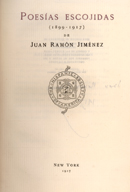
These are years of intellectual development, as the earlier ones had been years of sentimental education, and that is certainly reflected in his poetry. From Estío (1915) to Piedra y cielo (1919) there is a remarkable change marked by his renunciation of any form of adornment and the pursuit of the naked word. These are also years of extraordinary social and public activity. From 1914 on, he is responsible for organizing the Residencia library, and, together with Jiménez Fraud, directing its publications.
The intellectual stimulus at the Residencia and his relationship with Ortega were certainly prolific, and the philosopher’s influence on the writings of the poet is easy to trace. Even more significant is his relationship with Zenobia, and Diario de un poeta recién casado is the best example.