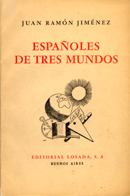
After Franco’s victory in the war, Juan Ramón suffered a great deal before accepting that his absence from Spain, which he initially thought would be brief, was for good. Sentenced to exile and forced to live a new life amidst another language, he, who had made the word his form of existence as an individual, had to learn to live again. Españoles de tres mundos (1942) is the book on which the poet built, for him and for others, that universe that the war denies him. In New York and at the universities of Miami, Duke and Maryland, Juan Ramón and Zenobia found much-needed tranquility, increasingly broken by moments of depression and illness, for the poet to return to his "work in progress,” which he continues to build and to distill.
A long visit to Buenos Aires and Montevideo would return the poet to his "lost Spanish" and his reunion with his “última plenitude," his “last prime” which encourages Juan Ramón to continue writing a series of texts (Espacio, En el otro costado, Una colina meridiana, Dios deseado y deseante and De ríos que se van). In these works, "the Universal Andalusian" finally understands how the successive metamorphoses of his writing make sense in the ultimate result. All his work in poetry had been moving toward building “un ámbito infinito lleno de ecos, signos y límites,” a consciousnessthat he would call, with no religious or theological pretensions, “god,” that is to say, “el nombre de una síntesis del universe,” (“the name of a synthesis of the universe”). The Nobel Prize in 1956 was in recognition of the "Work in progress" of a poet committed to the endless task of giving names to the unknown.