presentation

The government of the Second Republic established the Patronato de Misiones Pedagógicas by a decree on May 29, 1931. Its main objective was, as stated in the preamble, to bring to the people, “especially those living in rural areas, the vitality of progress and the means to participate in it and in its moral encouragement and universal examples so that all the peoples of Spain, even the most isolated,” would share “the benefits and noble pleasures enjoyed by the those living in cities.”

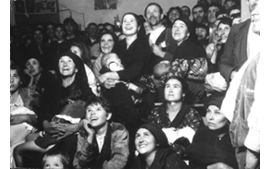
At the movies. At the bottom, center, the portable projector. Photo attributed to José Val del Omar. Biblioteca Nacional, Madrid
 

This was an idea that Francisco Giner de los Ríos and Manuel Bartolomé Cossío had proposed to the various governments of the Restoration since their founding of the Institución Libre de Enseñanza in 1876. They believed that in order to transform Spain into a democratic republic, it was necessary to shorten the distance between cities, which enjoyed better access to culture, while the peasantry plunged into isolation, unaware of the changes taking place in the world.
The activities of the Patronato focused on three aspects: promotion of general education, educational guidance for schools, and civic education of the rural population. To achieve those objectives, the Patronato established a library service, and to encourage a healthy taste in literature, it organized readings of romances, poems and short stories in villages. It also created the following traveling sections: the People’s Choir and Theater, the People’s Museum, a film section, the Puppet Show, and a music service that loaned gramophones and slate records.
To support the teachers in their everyday pedagogical task, the Patronato began to organize visits to rural schools in order to better understand the needs of the teachers, and then impart practical lessons, courses and implement educational excursions that provided teachers with better theoretical and methodological resources. There were also public meetings and lectures to inform the citizens about new political principles: democracy, universal suffrage, state structure, and so on.