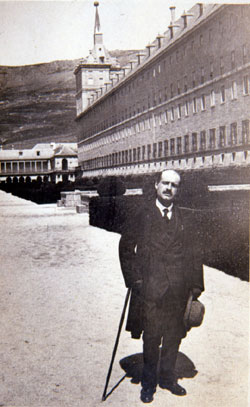
Ortega claims that to live is "to save” the circumstance. His was born into a family of journalists who introduced him to the intellectual milieu of a Madrid absorbed in the Restoration brought back by Cánovas. This privilege goes hand in hand with the responsibility for the res publica taken by the young Ortega. He decides to go to Germany to study philosophy at the most rigorous school, the neo-Kantian University of Marburg. In 1907, after his second stay in Germany and once he has assimilated the “social pedagogy” which he considered essential for the modernization of Spain (Kantian idealism), Ortega launched a campaign to convince the best liberal writers, artists and professionals that modernizing Spain meant “europeanizing” the country. That does not mean to import or to imitate, but to achieve, from the level of its own culture, the European standards.
Between 1907 and 1914, Ortega develops an intense dialogue between German philosophy and Spanish interpretation of the world as shown by Ramiro de Maeztu, Azorín, Pío Baroja, and especially Miguel de Unamuno. His essay Meditaciones del Quijote (1914) is his first philosophical synthesis. With his use of the word “integration” he opens the multiple meanings of this brief and inexhaustible book: integration of Madrid, Castilian and Mediterranean landscapes, and those with the German landscape.