landscape as educational tool
 
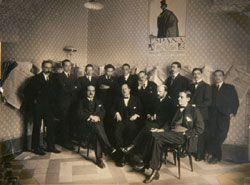
Ortega wrote tirelessly for newspapers owned by his family, like El Imparcial , and for  publishing companies that he helped to establish, like the Europa periodical (1910), and the weekly España (1915). Philosophy and politics run through parallel channels in Ortega's life, but not always in harmony. However, there is a clear spot where those two channels converge: his educational vocation that oozes from his work and explains his efforts to create new publishing projects. España, El Espectador, El Sol and Revista de Occidente were crucial for the development of a new sensitivity and knowledge of several generations of Spaniards during the first half of the 20th century.
Some members of the staff of the periodical España. From left to right, sat, José Ortega y Gasset, José Martínez  Ruiz (Azorín), Pío Baroja y Ramón Pérez de Ayala; standing, José Ruiz Castillo, Rafael de Penagos, an unidentified man, Luis Bagaría, Luis de Zulueta, Gustavo Pittaluga, Luis bello, Fernando Marco y García Bilbao, 1915. Fundación Ortega y Gasset, Madrid.

Ortega strongly underlined the originality of his own stand, but he was also very attentive and receptive to projects by other institutions which he supported, like the Ateneo of Madrid, the Residencia de Estudiantes, Editorial Calpe, and the Facultad de Filosofía y Letras (Humanities), at the Universidad Central, where he contributed to the reform of its study program.