madrid and the uncertain landscape of the republic
 
 The great intellectual effort that Ortega made in the preparation of lectures given in Argentina (1928) had a logical continuation in the university course he gave when he returned to Madrid, and in the collection of "folletones” (essays) published by El Sol throughout 1929 that became his most translated book, The revolt of the masses (1930). The same year, he published a series of articles on the crisis of the regime caused by the failure of Primo de Rivera’s dictatorship. He decided to participate in politics and founded the Agrupación al Servicio de la República together with Gregorio Marañón and Ramón Pérez de Ayala.
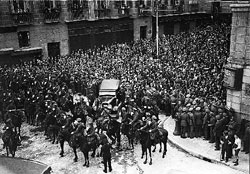
Opening of the Constituent Assembly and arrival of the delegation to Congress, Madrid, July 14, 1927. Photo by Alfonso. Archivo General de la Administración, Alcalá de Henares, Madrid.
He was elected member of the Constituent Assembly and intervened in debates on the Constitution, but soon he became disappointed with the politicians making the decisions about the Republic. He reacted by proposing his program “Rectificación de la República,” which was rejected. The Agrupación al Servicio de la República was dissolvedand he withdrew from all public activity. From then on, Ortega would be fully dedicated to his philosophical work, which reached its intellectual zenith between 1932 and 1936.  Outside this neat world of ideas, everything else seemed uncertain.