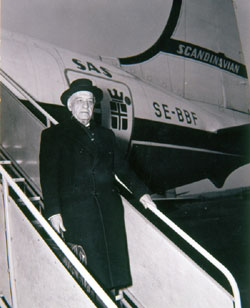
Ortega became ill shortly before the outbreak of civil war in July 1936 and took shelter with his family, at Alberto Jiménez Fraud’s invitation, in the Residencia de Estudiantes, which was under diplomatic protection for a few days. From there he went into exile in August, with brief stays in Grenoble, Paris, The Hague, Saint-Jean-de-Luz, Buenos Aires, La Plata, Lisbon and Cascais. In 1945, he returned briefly to Spain to spend some days in Zumaya. The following year he gave his lecture “Idea del teatro,” at the Madrid Ateneo, his only participation in an official institution affiliated with the dictatorship. Ortega lived his last ten years between his hometown and Lisbon, traveling frequently to other cities in Europe and America - where his books are still reissued with great success - and to lecture in several cities. He spent his free time reading and writing but would not publish another new work.
History, that human force that he wanted to understand, the “historical reason” at the core of his philosophy, ended up destroying the calm of his landscape. Recalling an observation by Bernard le Bovier de Fontenelle, Ortega liked to say that "life is to feel a certain difficulty to be".
|