





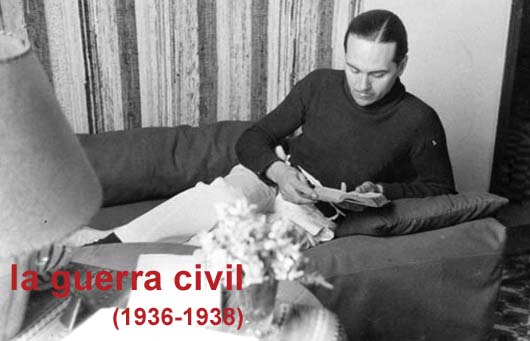
Luis Cernuda in his house on Viriato St., Madrid, March 9, 1936 Residencia de Estudiantes archives, Madrid
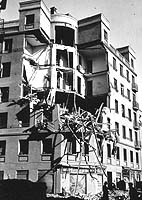
Viriato St., Madrid after bombing Biblioteca Nacional, Madrid
In the summer of 1936, Luis Cernuda and his friend Concha de Albornoz moved to Paris as secretaries to Álvaro de Albornoz, Spanish ambassador in France. Their stay was short-lived, because in September a commission headed by Dolores Ibarruri, la Pasionaria, arrived at the embassy. It accused Concha and Luis of sheltering spies in the embassy, and forced them to step down and leave the country.
Cernuda returned to Madrid where, for a few weeks, he worked with Arturo Serrano Plaja in the production of radio programs designed to boost morale of the loyal troops defending the capital. Perhaps Cernuda was eager to serve the Republican cause in a more committed way, and in late November he enlisted in the Alpine Battalion where he served as commissioner of culture. His battalion was stationed in the Sierra de Guadarrama, where the poet remained until January 1937 when, for unknown reasons, he returned to Madrid, and joined the Anti-Fascist Writers Alliance, headquartered on the Marqués del Duero Street. The poet published a short article supporting the Republic in El Mono Azul, the Alliance’s newsletter.
In April 1937, he moved to Valencia, where he contributed poems, such as “Elegía a un poeta muerto (F.G. L.)” to the periodical Hora de España. In August, he played the role of Don Pedro in the staging of Lorca’s Mariana Pineda, directed by Manuel Altolaguirre, with costumes designed by painter Victor María (Vitín) Cortezo. The performance was set to coincide with the II Congress of Antifascist Writers. The rehearsal helped the group to forget, for a while, the horrors of war, the bombing by Franco’s airplanes, but also the persecution that some of the Republican artists and intellectuals were suffering under the watchful eye of the political police.
Concha Albornoz was arrested on charges of espionage in the summer and Víctor María Cortezo was detained for being antirevolutionary. Cernuda was outraged (and anxious), but he did not leave the country. On the contrary, he rejected a job as lecturer in Oslo, and spent the winter of 1937-1938 in Madrid. Nevertheless, he finally accepted the invitation extended to him by the English poet Stanley Richardson to give a tour of lectures in England. On February 14, Cernuda left for Paris and London with his friend Bernabé Fernández-Canivell. When he crossed the border at Port-Bou, he had the firm intention of returning to Spain in spring. However, he was never able to return.
After Perfil del aire, Cernuda had only published Donde habite el olvido. He had four unpublished works: “Égloga, elegía y oda,” “Un río, un amor,” Los placeres prohibidos”and “Invocaciones.” In April 1936, after preparing a revised version of Perfil del aire - thereafter known as “Primeras poesías”- Cernuda collected his poems in a volume entitled La realidad y el deseo. Poets and critics such as Juan Ramón Jiménez, Pedro Salinas, Arturo Serrano Plaja and Manuel Altolaguirre received the book with high praise. But in the tribute from poets of his generation in a coffee shop on Botoneras St., in Madrid, on April 19, none spoke with more enthusiasm or more poetic insight than Federico García Lorca: «La realidad y el deseo me ha convencido con su perfección poética sin mácula, con su amorosa agonía encadenada, con su ira y sus piedras de sombra. Libro delicado y terrible al mismo tiempo, como un clave pálido que manara hilos de sangre por el temblor de cada cuerda» 6 .
The publication of La realidad y el deseo should have confirmed Cernuda as one of the greatest poets of his generation. However, history decided otherwise: in July 1936, the civil war broke out, ending, abruptly and violently, a period in the life of a whole generation. Whether or not anyone read Cernuda's poetry was something of little importance given the dramatic events facing the country.

