





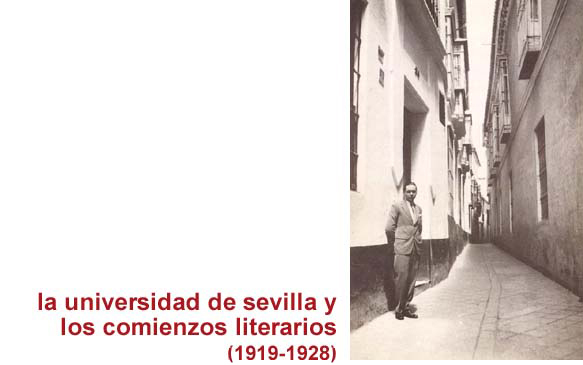
Luis Cernuda on Aire Street, Seville, 1928
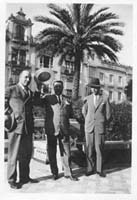
From left to right, Adriano del Valle, Fernando Villalón and Luis Cernuda. Seville, June 1928. Photo by Juan Guerrero Ruiz Residencia de Estudiantes archives, Madrid
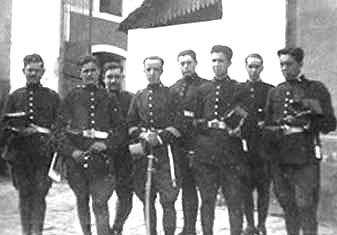
Luis Cernuda, second from right, with colleagues from the military school of Seville, c.1924. Private collection, Seville.
Cernuda enrolled in law school at the University of Seville in the fall of 1919. Perhaps he had not yet discovered his vocation as a poet, but the fact that Pedro Salinas, professor of history of Spanish language and literature, and one of the most prominent poets of the new generation, taught him during the first year of university probably encouraged him. He attended the literary tertulias that Salinas organized with other students such as Higinio Capote, José de Montes and Joaquín Romero y Murube. There, they read and studied the Spanish classics: Fray Luis de León, Góngora, Lope, Quevedo and Calderón; and also the modern French authors such as Baudelaire, Rimbaud, Proust, Reverdy, and André Gide.
Besides his growing interest in poetry, Cernuda highlighted a very special experience in the crystallization of his vocation as a poet, as he told in Historial de un libro:
“I was doing my military service and every afternoon I went riding with the other recruits, as part of instruction, on the outskirts of Seville. One day, without prior transition, things appeared to me as if I were seeing them for the first time, as if for the first time I came in contact with them, and at the same time this unusual vision provoked in me a strong urgency to express that experience. Thus a whole series of verses was born then, none of which survives.” 2 .
In 1920, Cernuda’s father died suddenly. The family was on the brink of bankruptcy and they moved to a more modest house on Conde Benomar St., also known as Air St. It was not surprising that, after graduating as a lawyer in 1925, his mother urged him to contribute to support the family, something in which the poet–in-the-making seemed not too interested. His increasingly growing poetic vocation would take him down a different path.
Juan Ramón Jiménez’s visit to Seville, in September 1925, helped strengthen Cernuda’s decision. He met and chatted with the most prestigious Spanish poet of the time, who, as Cernuda recalled in Historial de un libro, he read with true devotion: "I met him through Salinas, in Seville, one night in September 1925, in the Alcázar. I hardly spoke, feeling like a provincial boy, a young poet in front of the almost mythical great poet. I used to read and read again, with the fervor of a neophyte, several of his books: Segunda antolojía poética, Diario de un poeta recién casado, Poesía, Belleza...” 3 .
The mention of the Alcázar’s gardens is not a coincidence, for, long before the summer of 1925, those gardens, with their courtyards and fountains, shaded trails and quiet corners, had become a locus amoenus for Cernuda. They would return in the long years of his exile, especially in the prose poems of Ocnos and Variaciones sobre tema mexicano, and the poet from Seville would look for this lost paradise again and again.
Cernuda published some of his first poems in the Revista de Occidente, 1925. He also collaborated with other periodicals, such as La Verdad, Litoral, Mediodía and Papel de Aleluyas. His first book, Perfil del aire, with poems written between 1924 and early 1926, was published by editors Emilio Prados and Manuel Altolaguirre in their printing house, Sur, in Malaga, April 1927. The reception of the book by the press was very disappointing: with one or two exceptions, critics rejected the poems as anachronistic and alien to the rhythms of modernity, and some even denounced Cernuda as being a simple imitator of Jorge Guillén’s great poetry.
These criticisms provoked in Cernuda mistrust and animosity toward the Spanish literary circles that would increase when, some months later, he was not invited to participate in the celebrated tribute to Góngora, held at Seville’s Ateneo. However, this event provided him with the opportunity to meet other poets of his generation, including Federico García Lorca.
It was then when Cernuda turned away from the current Spanish literature. As early as 1926, he had begun to identify himself with the discontent and the rebellion of French surrealism as expressed by Aragon and Éluard.
He also read Lautréamont, Baudelaire, Rimbaud and André Gide. Nevertheless, he did not dare to give free rein to the deep concerns he shared with those writers. Hence, his long poems “Égloga,” “Elegía,” and “Oda,” written between 1927 and 1928, inspired by Mallarmé and Garcilaso, were very beautiful formal exercises, but they hardly expressed the anger and frustration boiling inside the young poet.

